Level up your business security with free, on-demand training and certification. Explore 1Password Academy today →
windows
45 Topics
1Password-CLI not working
I'm installing 1Password-CLI on a new computer and I'm getting this error: [ERROR] 2025/05/09 15:34:50 connecting to desktop app: write: The pipe is being closed. Looking at the previous thread here: CLI can not connect to desktop app | 1Password CommunitySolved1.9KViews7likes16Comments
Win11 -> WSL2 -> devcontainer ssh-add not accessible anymore
Hi all, I'm working on Windows 11 Pro, where 1 Password in the latest stable version is installed. I have WSL2 enabled with Ubuntu 24.04 installed and inside there I have docker installed to run devcontainers for VS Code. In 1Password I have all my ssh keys to interact with git and I have the ssh-agent option enabled. On Windows I can see all my keys in a terminal when executing ssh-add -l. In WSL I can also see all keys when executing ssh-add.exe -l and when opening a cloned repository in WSL in VS Code, the authentication works fine. (I love it). Now up until a couple days ago, I could also open a repository which has been cloned into WSL inside a devcontainer and the ssh agent forwarding was working like a charm, I could even sign commits, I have no clue how this magic works, but I loved it. Then it stopped working and I can't figure out why. Of course, all involved tools (Windows, WSL, VSCode, 1Password, etc.) install updates in the background, so it could be due to this. I disabled and enabled the 1Password ssh agent in the settings, no difference. I recreated the WSL instance, no difference. I reinstalled 1Password. In the VSCode devcontainer extension is the option to forward services, that is still checked, I tried toggling that as well. In WSL I still see the keys via ssh-add -l, but when I do the same inside a devcontainer I only see: Could not open a connection to your authentication agent. When I check the value of $SSH_AUTH_SOCK it is empty in both WSL and devcontainer, should it have a value? In the 1Password help around this topic I couldn't find it mentioned anymore. If this setup is still working for someone else, could you please check the value of this variable and post it?Solved1.5KViews3likes14CommentsAllow Warp as terminal to open SSH URLs
http://warp.dev is a popular terminal emulator that support both MacOS, Windows and Linux. It's popular and should be considered relevant enough. It would be great to support this Terminal within Settings -> Developer -> SSH Agent -> Advanced -> Open SSH URLs with.170Views3likes1CommentLocal .env file option not available
The "Local .env file" options is not shown in my destination options for environments. The only options I have is AWS Secrets Manager. I tried with both my Business and Personal accounts and I have the same behaviour. Am I missing something here ? Do I have to enable a certain setting so that this option is available ? Thank you for your help!Solved258Views2likes5Comments
Copy secret reference (using ID values)
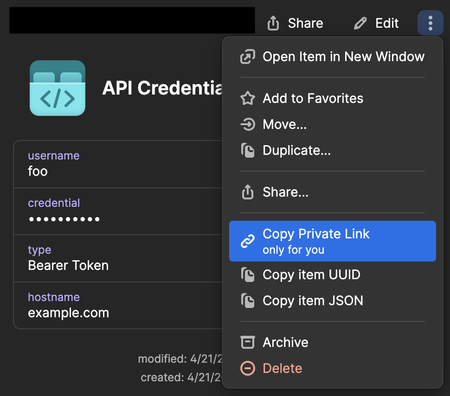
This applies to all platforms (not just Mac), but I didn't see a community category for "all platforms", so I'm choosing Mac because it seems to have the highest user activity Perhaps I've missed some documentation, but I don't find a way to copy a https://developer.1password.com/docs/cli/secrets-reference-syntax/ using the desktop app. This seems like a basic and essential task during development. What I want is this format: op://vault_id/item_id/section_id/field_id or if the value isn't in a section: op://vault_id/item_id/field_id How can I do that easily — and get a secret reference defined by ID values (which should be immutable — vs. name values which can be modified)? More context: I find some ways to construct the URL manually (but this is not ideal): A URL can be copied which includes the vault and item ID among other query parameters: I get one in a format like this: https://start.1password.com/open/i?v={VAULT_ID}&i={ITEM_ID} However, that's not enough as it doesn't include the section/field, and would need to be manually edited or processed by other tooling as an additional step to get the required output. I can also use "Copy item UUID" and then paste that as an argument to a manually-typed CLI command to get much more than what's needed: % op --format=json item get x5k2wndiih6cmw2rugl7ol442i { "id": "x5k2wndiih6cmw2rugl7ol442i", // --- snip --- "vault": { "id": "{REDACTED_VAULT_ID}", // --- snip --- }, // --- snip --- "fields": [ // --- snip --- { "id": "credential", "type": "CONCEALED", "label": "credential", "value": "abc123", "reference": "op://{REDACTED_VAULT_NAME}/API Credential/credential" }, // --- snip --- ] } However, this still involves either manually copying+pasting IDs or using other tooling to parse and create the required output. The JSON does include a reference value for the target field, but the reference is built using names, which isn't satisfactory for the reasons described previously. For the example above, what I want to copy to the clipboard is the following (where {VAULT_ID} is replaced by the actual vault ID): op://{VAULT_ID}/x5k2wndiih6cmw2rugl7ol442i/credential I think that if the boolean option is enabled at Settings > Advanced > Show debugging tools: then there should be an option to copy a complete ID-based secret reference for every field in its contextual menu: This is a re-posting of previous issue — the 1Password team stopped responding and it was closed without comment: https://1password.community/discussion/139642/copy-secret-reference-using-id-values 1Password Version: 8.10.48 Extension Version: Not Provided OS Version: macOS 15.0.1 Browser: Not Provided333Views1like10CommentsNew getting-started guides, AI search, and LLM-ready docs for 1Password dev tools at 1password.dev
Hi everyone! We've been investing in making 1Password's developer documentation genuinely useful from the first click, and we wanted to share what's now live over at 1password.dev. 📖 New getting-started guides We've published workflow-based getting-started guides across every major tool area: SSH & Git, 1Password CLI, SDKs (Go, JavaScript, Python), Environments, integrations, and more. Instead of jumping between reference pages, you can follow a clear path from setup to working integration, organized around how you actually build. 🔍 AI-powered search across the docs You can hit Ctrl+K on any page and ask a question in plain language. The built-in AI assistant searches the full documentation set and gives you a direct answer with links to the relevant pages. It’s a much faster way to find what you need, especially if you’re not sure which tool or section to look in. Try it: open 1password.dev, hit ⌘+K, and type “How do I set up git commit signing with multiple GitHub accounts?” 🤖 Docs built for AI dev workflows If you use AI coding assistants like Cursor, Copilot, Windsurf, or Claude, our docs are now natively consumable. Every page is available as Markdown (append .md to any URL), and we serve llms.txt and llms-full.txt at the site root so your tools can reference 1Password docs directly. Details here: Build with LLMs 🏗️ Refreshed docs structure The documentation is now organized around the way developers work, with clearer navigation across SSH & Git, CLI, SDKs, Environments, secrets management, and integrations. If you've found our docs hard to navigate in the past, it's worth another look. 📌 One practical note: our developer docs now live at 1password.dev. All your existing developer.1password.com links and bookmarks redirect automatically, so nothing breaks. We'd love your feedback If you run into any issues or have suggestions, let us know in this thread. You can also reach us in the 1Password Developers Slack. Happy building! 🔐65Views1like0Comments
WSL2 + 1Password CLI
I have a WSL2 system set up with NixOS where I used to be able to use shell plugins (primarily the `gh` tool for GitHub) - but today it is not working, throwing an error message: [ERROR] 2025/12/27 22:35:25 Shell Plugins can only be used with the 1Password app integration enabled. To learn more about this feature, check out: https://developer.1password.com/docs/cli/about-biometric-unlock/ This used to work - but unfortunately I don't know exactly _when_ it stopped working, I use the VM sporadically. Config: $ op plugin inspect ? Choose which CLI configuration to inspect: gh (GitHub) GitHub CLI Configured Aliases ✔ Alias for "gh" configured ✔ Aliases sourced (/home/gac/.config/op/plugins.sh) Configured Credentials ✔ Configured as global default: CREDENTIAL TYPE ITEM VAULT GitHub Personal Access Token GitHub Personal Access Token Private Versions: $ uname -a Linux wsl 6.6.87.2-microsoft-standard-WSL2 #1 SMP PREEMPT_DYNAMIC Thu Jun 5 18:30:46 UTC 2025 x86_64 GNU/Linux $ nixos-version 25.11.20251226.f560cce (Xantusia) $ op --version 2.32.0 $ wsl.exe --version WSL version: 2.6.3.0 Kernel version: 6.6.87.2-1 WSLg version: 1.0.71 MSRDC version: 1.2.6353 Direct3D version: 1.611.1-81528511 DXCore version: 10.0.26100.1-240331-1435.ge-release Windows version: 10.0.26200.7462 If biometric login is a hard requirement then this is problematic to say the least as this is a desktop - there is no Windows Hello and no biometric capability. The documentation page does redirect to a different page about app integration, however this seems to only cover common use cases such as "I am using Windows and I want access to 1Password from Powershell" or "I have macOS and want access from the native terminal with `bash`/`zsh`". There doesn't seem to be any advice for running within a WSL2 virtual machine where 1Password is running _outside_ of the VM and I need access for shell plugins _inside_ the VM... Any tips or advice?208Views1like0Comments
SSH agent requires restart between every GitHub request
I've been using the 1Password SSH agent to sign commits and authenticate with GitHub for months without any issues. Today, I started experiencing intermittent SSH timeouts when trying to pull, fetch, or push: ssh: connect to host github.com port 22: Connection timed out fatal: Could not read from remote repository. Please make sure you have the correct access rights and the repository exists. At first I assumed this was a GitHub outage, but I noticed that when 1Password prompted me to approve the SSH key, the request would succeed. After a while, the timeouts would return. I changed "Remember key approval" from 12 hours to "until 1Password quits." This helped, but now I have to restart 1Password and re-approve the key between every single Git request, otherwise it times out again. Environment: Windows 11 Affects Git CLI, Git Fork, and VS Code Commit signing with the same key still works fine What I've tried: Changing "Remember key approval" to "until 1Password quits" Restarting 1Password (temporarily fixes it for one request) Restarting my computer Has anyone else run into this? Any suggestions would be appreciated.204Views1like2CommentsWSL2 Arm Build
The instructions provided for setting up WSL2 git signing do not work with Windows on ARM. [gpg "ssh"] program = "/mnt/c/Users/$WINDOWS_USERNAME/AppData/Local/1Password/app/8/op-ssh-sign-wsl" I believe that's because the op-ssh-sign-wsl binary isn't compiled for ARM.78Views1like3CommentsHow to add a custom port to SSH bookmarks
I've recently discovered 1Password's support for SSH bookmarks, which is nice. However one of my servers does not use SSH port 22 but a different one. How can I add this custom port to a bookmark so that the generated SSH config file in ~/.ssh/1Password does contain the port info?Solved742Views1like9Comments