Level up your business security with free, on-demand training and certification. Explore 1Password Academy today →
macos
82 Topics
CLI Slow Performance
I have the 1Password desktop app installed and up to date on my macBook Pro, the `op` CLI is also installed, up to date, and working properly. All expected CLI queries work but they are surprisingly slow. After a bunch of trial and error, it seems that it is making a round-trip online as part of every single CLI query. I added the --debug flag and I can see cache hits, but the round trip online is still occurring. Disabling the network interface causes all queries to fail. Is it possible to get the 1Password CLI working fully offline to avoid all of this unnecessary round-trip business? Surely with the desktop app installed and CLI integration turned on, there has to be a way to make efficient (and offline) use of my 1Password vaults. Otherwise automation tasks that require secrets are simply too cumbersome to handle with 1Password, and I will require a secondary solution. And in that case, I may as well give up on 1Password.1KViews3likes13Comments1password locks within 10 seconds on High Performance or Dynamic resolution screen share on macOS
As the subject notes, I've noticed 1password locks itself within about 10 seconds regardless of what I've set the auto-lock setting to. This makes copying and grabbing passwords, otp codes etc very difficult as I need to do it within 10 seconds of opening 1password. This has been happening for quite some time (6+ months at least) when I run screen shares with a remote macOS host via the screen share app using High Performance or Dynamic Resolution. The issue does not occur if I change from High Performance to standard in the macOS screen share app. High Performance is useful as it adjusts the remote display to match the display I'm using on my local machine. Which makes needing to switch back to standard - not ideal. The remote machine display does not scale nicely if in standard screen share type mode. I was wondering if anyone else has seen this issue? Remote Mac is running MacOS 15.6.1 1password ver. 8.11.6655Views3likes33Comments
Allow Warp as terminal to open SSH URLs
http://warp.dev is a popular terminal emulator that support both MacOS, Windows and Linux. It's popular and should be considered relevant enough. It would be great to support this Terminal within Settings -> Developer -> SSH Agent -> Advanced -> Open SSH URLs with.173Views3likes1CommentMac client v8.10.80 released June 10 2025 is painfully slow
Since the 8.10.80 update on June 10th, the Mac app on Apple Silicon is painfully slow - the app takes around 30 seconds to respond when switching to it from another app, and when it starts responding, the UI response speed varies from immediate (i.e. normal) to upwards of 30 seconds again. Switching to the Beta version currently available doesn't fix the problem. Is there a way I can download older versions so I can roll back to try and see if an older version fixes this, please? AlexSolved1.3KViews2likes14Comments
Copy secret reference (using ID values)
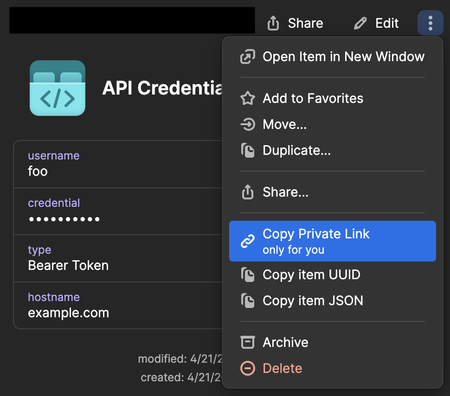
This applies to all platforms (not just Mac), but I didn't see a community category for "all platforms", so I'm choosing Mac because it seems to have the highest user activity Perhaps I've missed some documentation, but I don't find a way to copy a https://developer.1password.com/docs/cli/secrets-reference-syntax/ using the desktop app. This seems like a basic and essential task during development. What I want is this format: op://vault_id/item_id/section_id/field_id or if the value isn't in a section: op://vault_id/item_id/field_id How can I do that easily — and get a secret reference defined by ID values (which should be immutable — vs. name values which can be modified)? More context: I find some ways to construct the URL manually (but this is not ideal): A URL can be copied which includes the vault and item ID among other query parameters: I get one in a format like this: https://start.1password.com/open/i?v={VAULT_ID}&i={ITEM_ID} However, that's not enough as it doesn't include the section/field, and would need to be manually edited or processed by other tooling as an additional step to get the required output. I can also use "Copy item UUID" and then paste that as an argument to a manually-typed CLI command to get much more than what's needed: % op --format=json item get x5k2wndiih6cmw2rugl7ol442i { "id": "x5k2wndiih6cmw2rugl7ol442i", // --- snip --- "vault": { "id": "{REDACTED_VAULT_ID}", // --- snip --- }, // --- snip --- "fields": [ // --- snip --- { "id": "credential", "type": "CONCEALED", "label": "credential", "value": "abc123", "reference": "op://{REDACTED_VAULT_NAME}/API Credential/credential" }, // --- snip --- ] } However, this still involves either manually copying+pasting IDs or using other tooling to parse and create the required output. The JSON does include a reference value for the target field, but the reference is built using names, which isn't satisfactory for the reasons described previously. For the example above, what I want to copy to the clipboard is the following (where {VAULT_ID} is replaced by the actual vault ID): op://{VAULT_ID}/x5k2wndiih6cmw2rugl7ol442i/credential I think that if the boolean option is enabled at Settings > Advanced > Show debugging tools: then there should be an option to copy a complete ID-based secret reference for every field in its contextual menu: This is a re-posting of previous issue — the 1Password team stopped responding and it was closed without comment: https://1password.community/discussion/139642/copy-secret-reference-using-id-values 1Password Version: 8.10.48 Extension Version: Not Provided OS Version: macOS 15.0.1 Browser: Not Provided339Views1like10CommentsNew getting-started guides, AI search, and LLM-ready docs for 1Password dev tools at 1password.dev
Hi everyone! We've been investing in making 1Password's developer documentation genuinely useful from the first click, and we wanted to share what's now live over at 1password.dev. 📖 New getting-started guides We've published workflow-based getting-started guides across every major tool area: SSH & Git, 1Password CLI, SDKs (Go, JavaScript, Python), Environments, integrations, and more. Instead of jumping between reference pages, you can follow a clear path from setup to working integration, organized around how you actually build. 🔍 AI-powered search across the docs You can hit Ctrl+K on any page and ask a question in plain language. The built-in AI assistant searches the full documentation set and gives you a direct answer with links to the relevant pages. It’s a much faster way to find what you need, especially if you’re not sure which tool or section to look in. Try it: open 1password.dev, hit ⌘+K, and type “How do I set up git commit signing with multiple GitHub accounts?” 🤖 Docs built for AI dev workflows If you use AI coding assistants like Cursor, Copilot, Windsurf, or Claude, our docs are now natively consumable. Every page is available as Markdown (append .md to any URL), and we serve llms.txt and llms-full.txt at the site root so your tools can reference 1Password docs directly. Details here: Build with LLMs 🏗️ Refreshed docs structure The documentation is now organized around the way developers work, with clearer navigation across SSH & Git, CLI, SDKs, Environments, secrets management, and integrations. If you've found our docs hard to navigate in the past, it's worth another look. 📌 One practical note: our developer docs now live at 1password.dev. All your existing developer.1password.com links and bookmarks redirect automatically, so nothing breaks. We'd love your feedback If you run into any issues or have suggestions, let us know in this thread. You can also reach us in the 1Password Developers Slack. Happy building! 🔐71Views1like0Comments
Feature request: Path-aware login suggestions for multiple credentials on the same domain
I'd like to file a feature request and share a use case where the current "domain-only" matching makes day-to-day autofill noticeably worse, and to ask whether path-aware matching could be reconsidered as an opt-in option Up front: I can see from a quick search that this is clearly a much-requested feature, with threads going back what feels like several presidential administrations. Normally I'd just add a thumbs-up to the canonical request rather than start a new thread - but without a feature-request tracker (more on that at the end), I genuinely couldn't tell which of the many overlapping discussions is the "live" one the team is actually watching, vs. the ones now being slowly reclaimed by the forum equivalent of moss. So I'm posting fresh rather than guessing wrong and shouting into a tomb. Apologies for the duplication; please feel free to merge this into whichever discussion is currently canonical. ## The situation I have multiple distinct logins on the same domain, distinguished only by path. For example: - https://[example.com]/[teamA]/login -> Login A - https://[example.com]/[teamB]/login -> Login B - https://[example.com]/[admin]/login -> Login C Because 1Password matches on eTLD+1 and ignores the path for suggestions, all three credentials surface every time I land on any of these pages. There is no way to tell 1Password "when the URL path starts with /teamA, prefer Login A," which means every login attempt is a small multiple-choice quiz I am demonstrably bad at. ## Why this matters The "pick from a list" flow is fine for an occasional ambiguity, but in this scenario it happens on every single login. I autofill the wrong credential maybe 1 in 3 times, which - and I cannot stress this enough - triggers the account lockout flow on at least one of these systems. My password manager and I are, in effect, collaborating to lock me out of my own accounts. Favoriting helps for exactly one of them; the others remain a coin flip with worse odds. I understand from past forum threads that 1Password removed path matching some years ago because it complicated things for typical users, and that the team is (rightly) conservative about adding options. I'm not asking for the old behavior back as a default - I'm asking whether a per-item, opt-in path constraint could fit the existing model: - Today's "Fill anywhere on this website" -> unchanged default - Today's "Only fill on this exact host" -> already path-blind - New: "Only fill when URL path starts with ..." (per Website entry) That mirrors the existing exact-host option, just one level deeper. No regex, no globs, no Turing-complete URL DSL - just a path-prefix string on the Website field when the user explicitly opts in. Items without the new option behave exactly as they do today, so there's no impact on users who don't need this. ## Alternatives I've tried - Favoriting: only helps one of N items. - Exact-host: doesn't help because the host is identical. - Splitting into separate Website entries: doesn't help because the path is dropped from matching. - Open-and-fill from the 1Password app: works, but defeats the purpose of an in-browser password manager for daily logins - at that point I'm essentially using 1Password as a fancy bookmarks menu. ## A small meta note This connects to the situation I described at the top. I understand the team's reasoning for not running a formal voting system - that vote counts don't capture the "why" behind a request, and that discussion surfaces better signal. Both of those things are true. But the current setup also means there's no way for users with the same underlying problem to converge on a single canonical request, no visible signal of how widespread an issue is, and no acknowledgement loop telling requesters whether something is even on the radar. The current incentive structure rewards starting yet another duplicate thread (hi!) over piling onto an older one nobody can confirm is still being read. A lightweight feature-request tracker - even one without public vote counts, if that's the concern - would make it easier for users like me to contribute signal without worrying we're duplicating a thread buried three pages deep. Worth considering alongside the substantive request above. Happy to discuss the use case further or test a beta if this is something the team is open to exploring. Thanks for considering it, and apologies again to whichever poor soul at 1Password has to read the seventeenth version of this request.45Views1like2Comments
Follow-up from 1Password article on Clawdbot/OpenClaw
hello there, Long-time 1Password customer here. Product is so good there was NO NEED for me to join this forum. I would argue it still is, and this discussion/question is more to understand how to use 1Password with OpenClaw or any AI agent in general. https://1password.com/blog/its-openclaw here mentioned about; a dedicated Mac mini with its own email address and its own 1Password account Any guide/pointer on how can I follow to set up the "its own 1Password account"? I have to figure out how to create own email address for Mac Mini (I already have an M1 Mac Mini from way back sitting idle). Thank you850Views1like5CommentsFrustrations with .env File Handling and Environments in 1Password
To whom it may concern, I just tried to add some basic .env files to 1Password and was honestly surprised at how difficult and unsatisfying the experience was. I’ve always considered 1Password a premium, polished product, and I’ve really enjoyed using it so far. But in this case, the lack of functionality is pretty disappointing. I know you recently launched the Environments beta, which seems like a step in the right direction, but it’s clearly not fully fleshed out. Most programming projects of mine include multiple environment files, not just one. Some values in these files are sensitive, and others aren’t, so we should be able to choose which fields are masked (as passwords) and which are shown normally. Importing and exporting environment files should also be seamless, currently, it’s anything but. But the biggest issue with Environments right now is that they apparently don’t belong to vaults. That means I can’t share them with coworkers, which makes them basically useless for team projects. What’s the point of having them at all if they can’t be shared? So I tried workarounds: First, I attempted to store the variables in a secure note. While you can manually add fields, that’s clunky and time-consuming. Then I tried uploading the .env file to the note, but on macOS, the file picker doesn’t show hidden files, and apparently there’s no way to make it do so. This made it impossible to upload the file with its original name, a really basic oversight, and one that shouldn’t exist in a premium product. Next, I tried using a Document item. At least the drag-and-drop upload worked (unlike Secure Notes), but now I’m locked into a document type that only allows a single file. That’s just not workable when a project has multiple secret environment files. Even worse, if I want to replace the file, the drag-and-drop UI disappears entirely, so I can’t upload a hidden file again. I’d have to delete the entire document and start over. That’s absurd. I genuinely respect the work you’ve done on 1Password; it’s one of the few tools I’ve used that felt reliable and trustworthy out of the box. But these gaps in functionality around something as basic as handling environment files are frustrating. And for a product at this price point, I expect this sort of workflow to just work. It’s hard to believe these limitations haven’t already been addressed. On top of that, it was surprisingly difficult to even find a proper way to give feedback like this. That feels like a mistake, if users can’t easily tell you where the product falls short, you miss the chance to improve it. Anyway, I needed to get this off my chest. I hope this feedback is helpful, and that we’ll see improvements to these features soon. Best regards, Joël Grosjean1.6KViews1like7Comments
"op inject" does not find item in vault
Hi, I'm currently trying to generate a .env file locally using a .env.reference containing secret references, but I keep getting an error when running op inject. Any help on this would be much appreciated. --- .env.reference APP_ENV="op://Env_Server_Local/APP_ENV/password" FRONTEND_APP_URL="op://Env_Server_Local/FRONTEND_APP_URL/password" SERVER_URL="op://Env_Server_Local/SERVER_URL/password" > When running op read, it works % op read op://Env_Server_Local/APP_ENV/password development > When running op inject to generate the .env file, it fails. The secret does exist and was not deleted or archived. % op inject -i packages/server/.env.reference -o packages/server/.env [ERROR] 2025/06/13 08:45:14 could not find item APP_ENV in vault Env_Server_Local, because it has been deleted or archived. Please restore the item if you want to use it with secret provisioning. I feel it might be due to adding new items to the vault / updating existing items. --- 1password-cli : 2.31.1 desktop app: 1Password for Mac 8.10.80 (81080023) ---- This is blocking us from fully integrating 1password as secrets manager. Any help appreciated 🙏98Views1like1Comment