Protect what matters – even after you're gone. Make a plan for your digital legacy today.
windows
3004 Topics1Password using wrong accent color on Windows 10
With the most recent update (1Password for Windows 8.11.16 (81116035)), the app started using the wrong accent color when set to system default. This applies to any accent color, not just the default blue. See the attached screenshot, which shows the Windows accent color next to the 1Password app (using the wrong color).279Views3likes5CommentsFeature Request: Show Original Contributor of Items in Shared Family Vaults
Summary Please add a built-in way to display who originally created or contributed an item to a shared vault in 1Password Family. Problem In shared family vaults, it is currently not possible to see who an item originally belongs to once it has been shared. This makes it unclear who owns a specific account, even though the item is visible to everyone in the family. As a workaround, we manually add tags with the name of the person who created or contributed the item. This allows sorting and filtering by owner, but it is manual, error-prone, and easy to forget. Proposed Feature Display non-editable metadata such as: “Contributed by: Name” or “Original owner: Name” This information should remain visible in the item details after sharing or moving an item into a shared family vault. Benefit This makes it easy to understand who an account actually belongs to, even when it is shared for convenience. It improves clarity in family vaults, avoids confusion, and removes the need for manual tagging. Reference Apple Passwords already shows this information for shared items using labels like “Contributed by: Name”, which provides clear ownership at a glance.18Views2likes3CommentsHTTP Basic Auth autofill should be capable of filling on load (maybe normal logins too?)
At work, we use a site that relies on an HTTP basic authentication dialog. My colleagues and I need to access this site multiple times a day, every day. Having to open 1Password and manually click “Autofill” each time quickly becomes frustrating, especially since there’s an additional login screen and 2FA on top of that. While I don’t think this should be enabled by default, I do believe the option should at least be available. More generally, this would be a nice QOA improvement regardless of whether HTTP basic auth is involved. If I’m already on a login page after explicitly clicking a button, I don't get why I should still have to manually select my account. Just something to think about 🙂14Views0likes0Commentscrypto.randomUUID is not a function S @ inject-content-scripts.js:5
FYI: I bumped into an error associated with 1Password Beta extension 8.10.56.22 when I was inspecting a site for an unrelated reason. This is not impacting me, just thought you might like to know. Site is http://atecconnectors.com/atec/index.cfm Chrome Dev console says "inject-content-scripts.js:5 Failed to fetch chrome-extension://khgocmkkpikpnmmkgmdnfckapcdkgfaf/inline/injected.js, Import failed 3 times. Final error: crypto.randomUUID is not a function S @ inject-content-scripts.js:5" The DevTools AI Assistant added this, which I didn't read but looks interesting: "Explanation Okay, let's break down why you're getting the "Failed to fetch ... Import failed 3 times. Final error: crypto.randomUUID is not a function" error and how to fix it. Understanding the Error The error message tells us a few critical things: Failed to Fetch: The browser is trying to load a JavaScript file from a Chrome extension ( chrome-extension://khgocmkkpikpnmmkgmdnfckapcdkgfaf/inline/injected.js). Import Failed 3 Times: The browser attempted to load the file three times and failed each time. This suggests the issue is not a temporary network hiccup but something fundamental. crypto.randomUUID is not a function: This is the root cause of the failure. The crypto.randomUUID() method is a relatively new web standard (part of the Web Crypto API) that is used to generate cryptographically secure UUIDs. The browser (or, more likely, the context where this code is running) doesn't support it. Where the Problem Likely Lies The problem is most likely in the injected.js file, as the error is complaining about something inside this extension file. Although the error is shown while your web app is working, the problem is not with your app code itself, but rather, the extension injecting this injected.js file. Older Extension Code: The extension is injecting a file that uses crypto.randomUUID(). If the extension was built targeting an older version of Chrome or a different browser that didn't support crypto.randomUUID(), this method may have been added later or not added by the extension authors. Old browser version: An old browser version may not support crypto.randomUUID. Why Your Web App Code is Involved (Indirectly) Your web app's code triggers the extension's injection mechanism. Your code doesn't directly use crypto.randomUUID(). Dissecting the Given Code (and How it Relates) Let's look at the code snippet you provided and see how it contributes to triggering the error, even if it's not causing it: Code (l),i.filter(p).forEach(s=>{let u=b();e.addEventListener("DOMContentLoaded",()=>{l(s).then(u.resolve)},{once:!0}),a=[...a,u.promise]})):(`${n}`,a=[...c,...i].filter(p).map(l)),Promise.all(a)},y=()=>{let e=chrome.runtime.getURL(""),t=new URL(e),r=t.protocol,o=t.host;return`${r}//${o}`},m=(e,t)=>{chrome.runtime.sendMessage({name:"report-error",data:{name:"InjectContentScript",message:e,severity:"error",stack:t}})},S=(e,t)=>{if(!h(e)){console.error(t),m(t);return}let r=`${t}, ${e.message}`;console.error(r),m(r,e.stack)},l=async e=>{if(`${n}${e.label}`,e.world==="ISOLATED")try{await C(e.path)}catch(t){return S(t,`Failed to fetch ${e.path}`),Promise.resolve(void 0)}else{let t="Only isolated script injection has been supported";throw m(t),new Error(t)}},C=async e=>{let t=[];try{await T(e);return}catch(i){t.push(i)}await d(25);try{await import(e);return}catch(i){t.push(i)}await d(50);try{await import(e);return}catch(i){t.push(i)}if(t.length===0)throw new Error("Logic error: unreachable code w Use code snippets with caution Content Script Injection: The code heavily suggests that it's part of a system for dynamically injecting content scripts (scripts that run in the context of a web page) into web pages. This is common for browser extensions. l Function: This is likely the main function for managing the injection of a script. It checks if the target world is "ISOLATED" (a way of running a script in a sandboxed environment). C Function: This is the function that actually attempts to load the script. It tries import() three times, with delays (d(25), d(50)) in between each attempt. The file it tries to import is given in e.path. The error message we are getting is probably coming from this code. chrome.runtime.getURL(): This function is crucial for extensions. It is getting the URL to fetch files from the extension itself. This makes the browser look inside the extension for the injected.js file. Error reporting: The code contains functions m and S which are sending errors to the extension, probably for debug or error tracking purposes. import(e): The repeated import(e) is the exact point where the error happens. When the injected.js is being imported, it uses the crypto.randomUUID, and since it is unsupported, it fails. Solution and Workarounds Since the problem is in an external extension file, you cannot directly modify the injected.js code. Your solutions are more about working around the issue or ensuring the extension is updated: Update the Extension: If the extension is from the Chrome Web Store, check if there's an update available. The extension's developer may have fixed this bug. Contact the extension support and report the issue. Find an Alternative Extension: If updating doesn't work or there's no update, see if there's a different extension that offers similar functionality and doesn't have this problem. Polyfill: If the extension is not maintained, a way to avoid the issue could be to implement a polyfill. This polyfill could be injected before the extension's injected.js and would create the crypto.randomUUID if it doesn't exists. Disable the Extension: If you don't need the extension at all, disable it in your browser's extension settings. Use a different browser: An old browser version could be the cause of the issue. Try using a newer browser version. Important Considerations Security: Be cautious about disabling security-related extensions. Make sure you understand the risks involved. Extension Development: If you are the developer of the extension, replace crypto.randomUUID() by a compatible UUID method or add a polyfill. In Summary The error "crypto.randomUUID is not a function" in your scenario means that the injected.js file within the extension is trying to use a feature that's not available in the execution environment. You can fix this by updating or replacing the extension, or by using a polyfill. You must investigate which extension is injecting this file. Data used to understand this message Use search instead AI tools may generate inaccurate info that doesn't represent Google's views. Data sent to Google may be seen by human reviewers to improve this feature. Open settings or learn more933Views0likes2CommentsBring 'custom trusted browser' feature to Windows
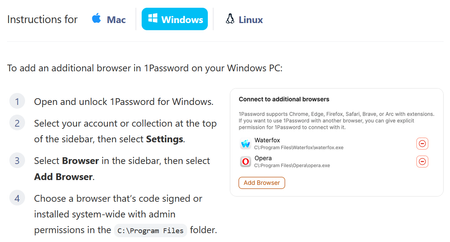
Following on for the various Opera-related requests that are 'solved' with either 'use a supported browser' or 'solved on mac': please bring this feature to Windows. My personal motivation is Chrome's recent neutering of ad blockers, combined with the excessive use of Windows system notifications for feature advertisement by Firefox and Edge, and the pushing of Web3/crypto nonsense in Brave.68Views1like4CommentsLogin icons not showing after an import
Hi, I have an existing vault where my icons for all my login items show, everything is fine etc. However I've created a new vault and have imported from bitwarden a large amount of entries. Even though I have 'Show app and website icons' selected, none of the icons for the imported sites show (just the default first and second letter. If I then go into one of these imports and remove the part of the website URL and add back, the icon then appears. So its as if its not triggering to look these up on import. I've tried production and nightly build but both the same result. Anyway to force an icon lookup for a vault, or to fix the import issue? Keen to move some family members over to a subscription plan, but obviously the nice to look at bit will become the most important part!Solved24Views0likes3CommentsSecurity settings were changed automatically somehow.
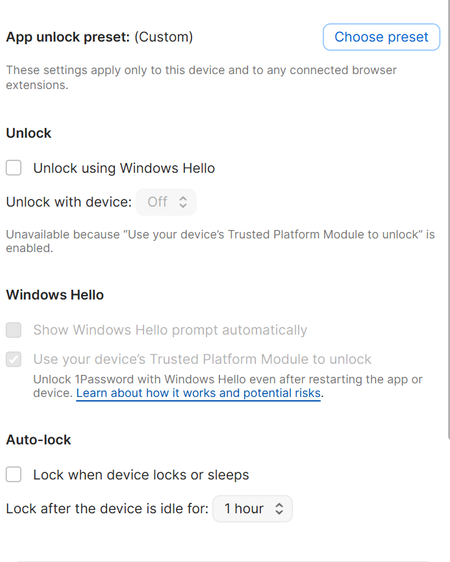
Short-time user (2 months). Everything was smooth until yesterday. All of a sudden, 1Password started asking me to enter my master password every time I started Edge (W11). Previously, it would only ask at long intervals (per the settings I had selected when I installed it). I looked, and many of my security settings had been changed to require this, including a setting to use Windows Hello, which (for several reasons), I never use (and cannot use). I put the settings back the way they were, but I need to understand how and why this can happen. If it's a result of a Windows update, I need to have a way to prevent it in the future. If it's a result of a 1Password update, I need to understand why the developers felt it appropriate to do so. Thanks.5Views0likes0CommentsShortcut (.lnk) does not work after update
After an update to 1Password, the shortcut (.lnk) to start the program is no longer valid. The only way I know to get a working shortcut is to access the .exe in: \Program Files\WindowsApps\Agilebits.1Password_... There must be an easier way. Why doesn't 1Password generate a shortcut for itself on update?13Views0likes3Comments1Password for Windows unexpectedly asked for my Secret Key
Thank you for opening this thread. I’d like to report that I’m experiencing the same issue. As of yesterday evening, I was able to sign in to 1Password and everything worked normally. However, this morning I can no longer log in because 1Password is now asking for my Secret Key. I’m certain I didn’t change my password or make any modifications. I simply shut down my computer last night and opened it again this morning. I can’t find my Secret Key anywhere, and this is the only device where I was signed in. I’m currently asking my team members to help me recover my account. Like Netpog mentioned, this feels like a very strange issue and shouldn’t happen. Without a Secret Key or an Emergency Kit backup, a user could permanently lose access to their account. OS: Window 10 Browser: Microsoft Edge - Version 143.0.3650.80 (Official build) (64-bit) Extension version: 8.11.20.3.9 cc @1P_Ti47Views0likes4Comments