Level up your business security with free, on-demand training and certification. Explore 1Password Academy today →
windows
88 Topics
Show the requested credential
I'm heavily using 1password now for agentic usage. All of my business is set up on it now, and all of my credentials are locally using op://, or service accounts. I've put in a lot of effort to try and isolate systems using least privilege, but one problem is that when agents (or applications) request a credential from the system, it doesn't say WHAT credential is being requested. Half the time it doesn't even say the correct name for the application making the request, either. This is a big problem, because I'm starting to get into the habit of just spamming "Accept" blindly. But the whole reason I have set up this whole pipeline is so I can catch malicious programs trying to gain access - for example, supply chain attack infections. Without seeing what credential is being requested, and the process information that is requesting it, I'm finding it's not actually adding much protection at all, because it's putting me into a false sense of security and promoting bad habits. If I'm running multiple agents in parallel, which is often the case, it might just say "Terminal requests access to your vault" or something similar. Which terminal is that? What is the underlying entity being requested? What credential? What is the process ID or terminal title, so I can isolate it to a terminal/agent? Etc. I think this is something that urgently needs to be added. Otherwise, as it stands, it's not really offering much protection because users will just go "oh, it's probably just that agent running - I'm sure it's fine" and accept everything. If that agent happened to have installed a malicious npm package, you'd probably catch it too late.41Views0likes3Comments
Tag navigation
Is there any information on whether and when this feature will be brought back? In a 1Password setup with a 5-digit number of logins and, consequently, a lot of tags, navigation is simply a real hassle... The “type to jump to” feature isn’t currently available because of a recent backend reengineering of the sidebar. I know that feature was really useful to some, so I’ve shared your feedback with the team and a feature request has been filed to explore bringing it back in the future. https://www.1password.community/discussions/1password-work/slowunresponsive-uiux-after-update-to-8-12-10-windows-desktop/169194/replies/16919727Views0likes1Comment
Error when onboarding new SSO User
1 Password for Enterprise SSO Method Entra Hosted SCIM Managed Group When I add a new user to a group to automatically onboard them now, when the user gets to the email verification step, that user gets "An Unknown Error Occurred" "Contact your account administrator for help.". below that in the response is "Error(SecureChannelCreateSession(Fetch)) \r\n at /builds/dev/cc/confidential-computing/crates/internal/cc-secure-channel-client/src/lib.rs:445" This did not happen with the first user to onboard through this group, but it has happened with all others. After 48 hours I was able to re-invite one of the users and push them through, but I want to know how to avoid this in the future.16Views0likes0Comments
Expiration report
I'm using the date field (new) and the alert expiration. But there is no view or report to list by this fields. and no pop up or something to have visibility of alerts. That means I have to go one by one entry to see that field. My question is if there is a expiration or alert report and how to access this?62Views0likes2Comments
AutoLock Driving Me Insane
On my Windows PC, 1Password is constantly locking prematurely despite the fact I have auto-lock set for the maximum 8 hours. I would prefer it never lock as I live/work alone but that doesn't seem to be an option. I have no idea how to stop the constantly locking many times each day.63Views0likes3Comments
lost most of favorites in 1password after the last 1password update
Hello, Yesterday I updated the 1Password client to the latest version "1Password for Windows 8.12.12". After that I lost most of my personal favorite items pinned in 'Favorites'. My colleagues reported about the opposite consequences - they got the favorites they didn't have before the update. I wonder if someone else got similar issues. Thanks!Solved63Views0likes5CommentsExtension Gets Stuck Saying "Unlocking..."
Within the past week, most of the users at our company have started experiencing an issue with the 1Password browser extension in both Chrome and Edge. After signing into the extension using SSO, the extension icon changes to show that it is unlocked — the lock icon disappears — but when the user clicks the extension to open the menu, it gets stuck on “Unlocking…” and never fully opens. We have found a temporary workaround, but it is inconsistent and not practical for regular use: Click the SSO button to unlock 1Password. After the SSO tab opens and closes, immediately click the 1Password extension again before the lock icon disappears. The extension briefly still shows the SSO button, then successfully unlocks and displays the menu. However, this only works temporarily. If the user tries to open the extension again on the same browser tab, it goes back to being stuck on “Unlocking…”. If the user switches to a different tab before opening it again, it appears to remain unlocked for the time being. This is affecting both Chrome and Edge. So far, the few users we have who are using Firefox do not appear to be affected. However, most of our users do not have have access to Firefox, so switching browsers is not a practical workaround for us. This also seemed to start around the time Chrome updated to Version 147.0.7727.102, which resolved the previous 1Password-related issue we were seeing, but this new issue started occurring afterward. Current versions in our environment: Chrome: 147.0.7727.103 Edge: 147.0.3912.86 Also worth noting: we do not have the 1Password desktop app installed on our users’ computers. They are using only the browser extensions. Has anyone else started seeing this behavior recently, especially in Chrome or Edge with SSO-only extension usage? Are there any known workarounds, policy settings, extension settings, or browser flags that may help resolve or mitigate this?Solved265Views0likes7CommentsAuto type not working on certain app after today's update to 8.12.12
We use a tool called CCH Pfx Practice Management. It was working great until today's update. I tried unchecking the auto-type box and re-checking it, but it still does not work. Our two other applications that are also from CCH and use auto-type, work just fine....so the auto-type feature is still working, just not on CCHPM. Any ideas? We also tried recreating a new login, but it did not work either. Thank you.48Views0likes3CommentsChrome passkey popup
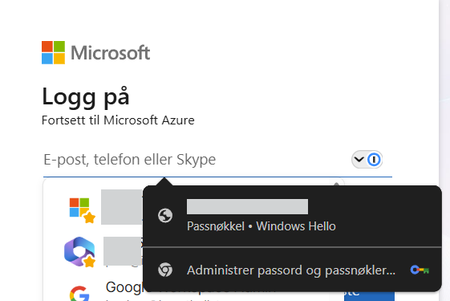
I have this issue where Chrome's passkey popup overlays 1Password. The device is Entra joined and the passkey is bound to the device. Deleting the passkey in Windows settings is not an option. Everytime i visit a Microsoft login page the Chrome passkey popup also shows over 1Password. This only happens when using Windows 11 + Chrome. Using Windows 11 + Microsoft Edge does not show any popup from MS. 1Password is set as the default password manager in Chrome Any recommendations? 1Password Version: 8.12.10 Extension Version: 8.12.12.44 OS Version: Windows 11 25H2 | 26200.8246 Browser: Chrome 124.0.7444.163Solved104Views0likes3Comments1Password for Windows Slow
For the past 2–3 weeks, Windows Client from 1Password has been extremely slow for almost all internal staff and customers (MSP version) – for example, when searching and then displaying the results – and keeps going offline (the red cloud appears and it has to be reconnected). When can we expect the situation to improve? It’s making work incredibly tedious. Version 8.12.12 and the Version before also.58Views0likes4Comments